KUNA
Immersive sound installation, in development
Kuna is an immersive sound installation that listens to the lullabies of Amazonian indigenous women as acts of transmission, care and resistance. Kuna extends my work with the Amazonian territory, proposing a space for listening through the relationship between mother and daughter or son. An intimate space of transmission, made of song and breast milk, through which protection, nourishment and memory pass, a memory that is not only personal but also cultural.
The Ríos Trilogy led me to work on the Amazon basin for six years through data: cartographies, topographies, models of the territory. What this work made clear is that the territory and the peoples who inhabit it cannot be thought of separately. In the Amazon basin, indigenous territories are, in practice, the best preserved, and this preservation comes from the sustained care of those who live in them.
Kuna carries this observation into the realm of language. Lullabies are a feminine, domestic and everyday genre, and they are often the last place where a language is still alive: what is no longer spoken is still sung. Language persists, like territory, wherever there is someone to sustain it.
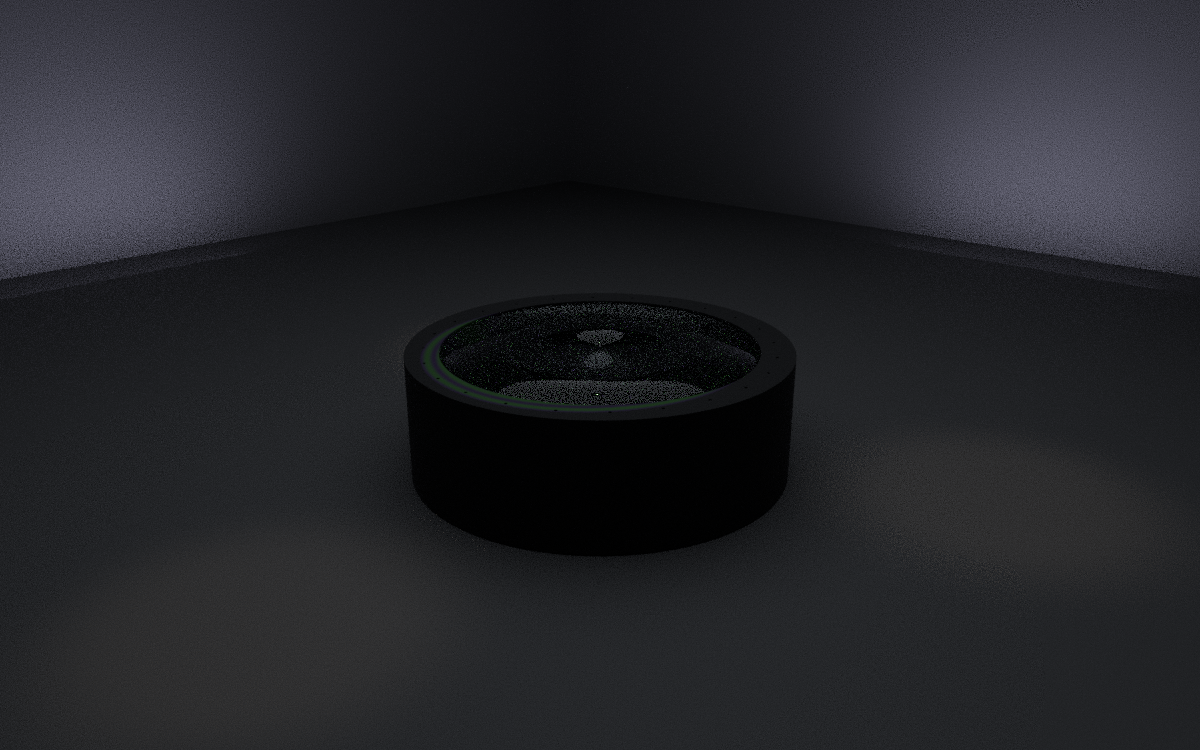
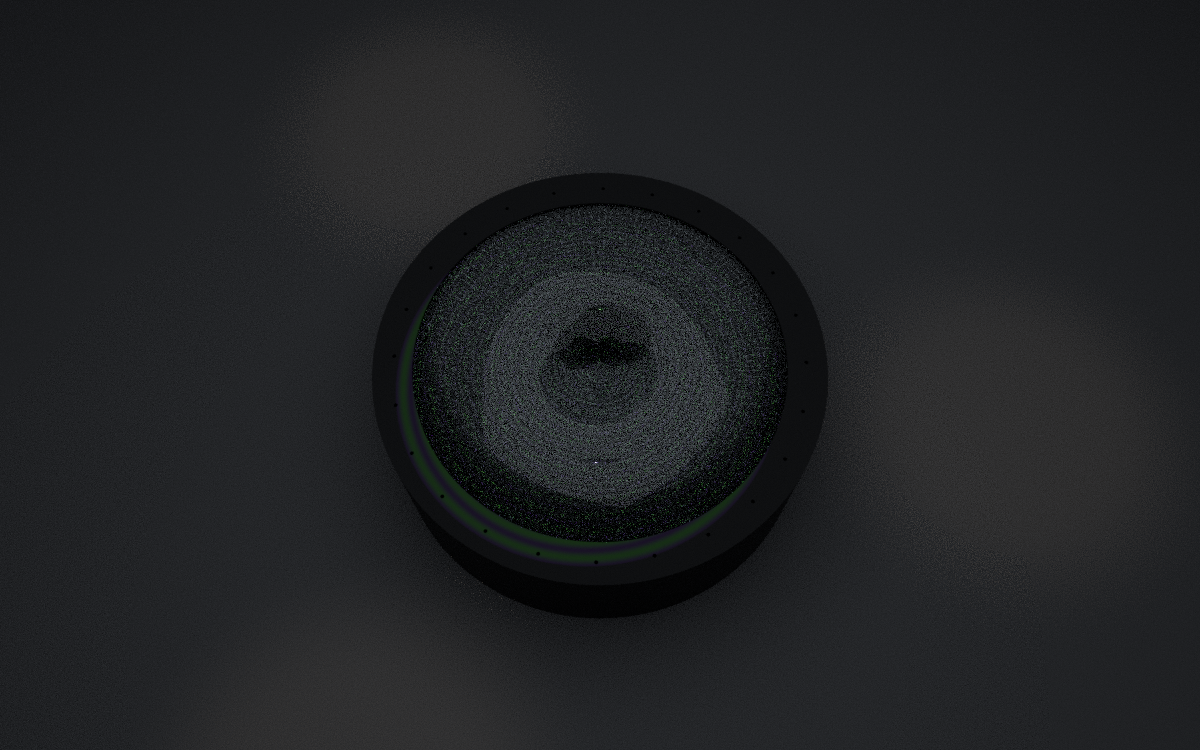
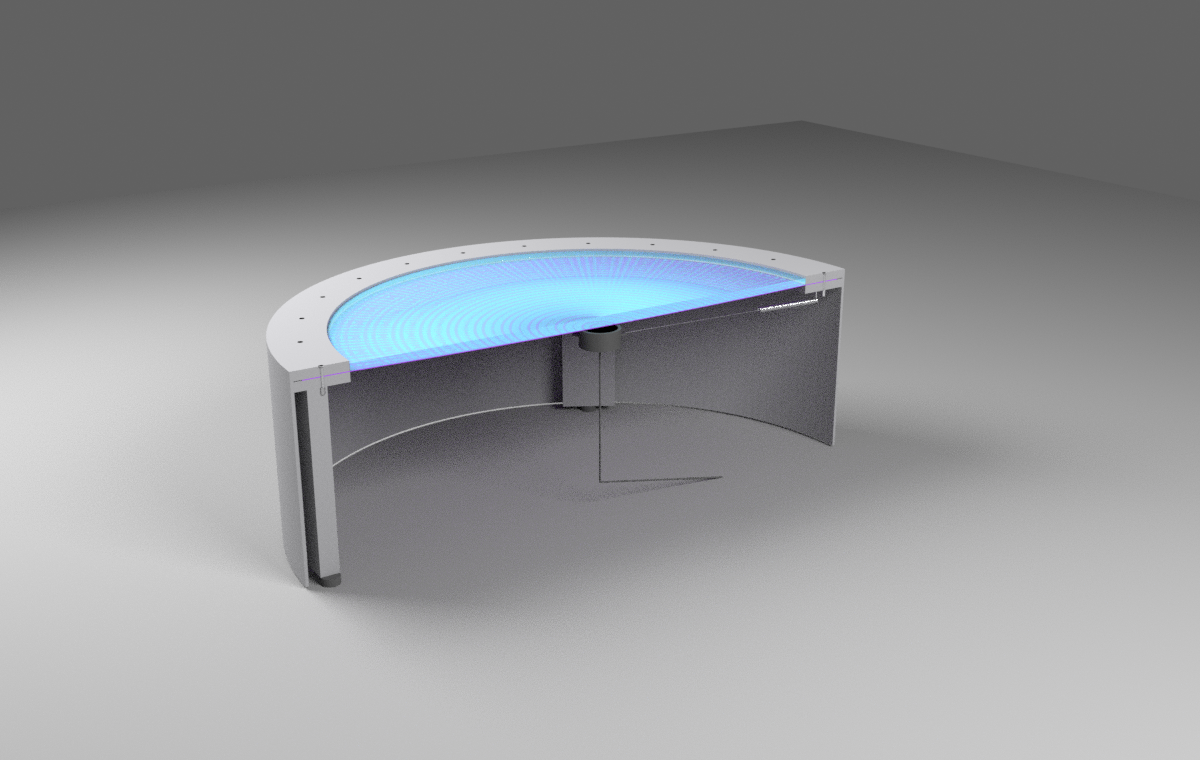
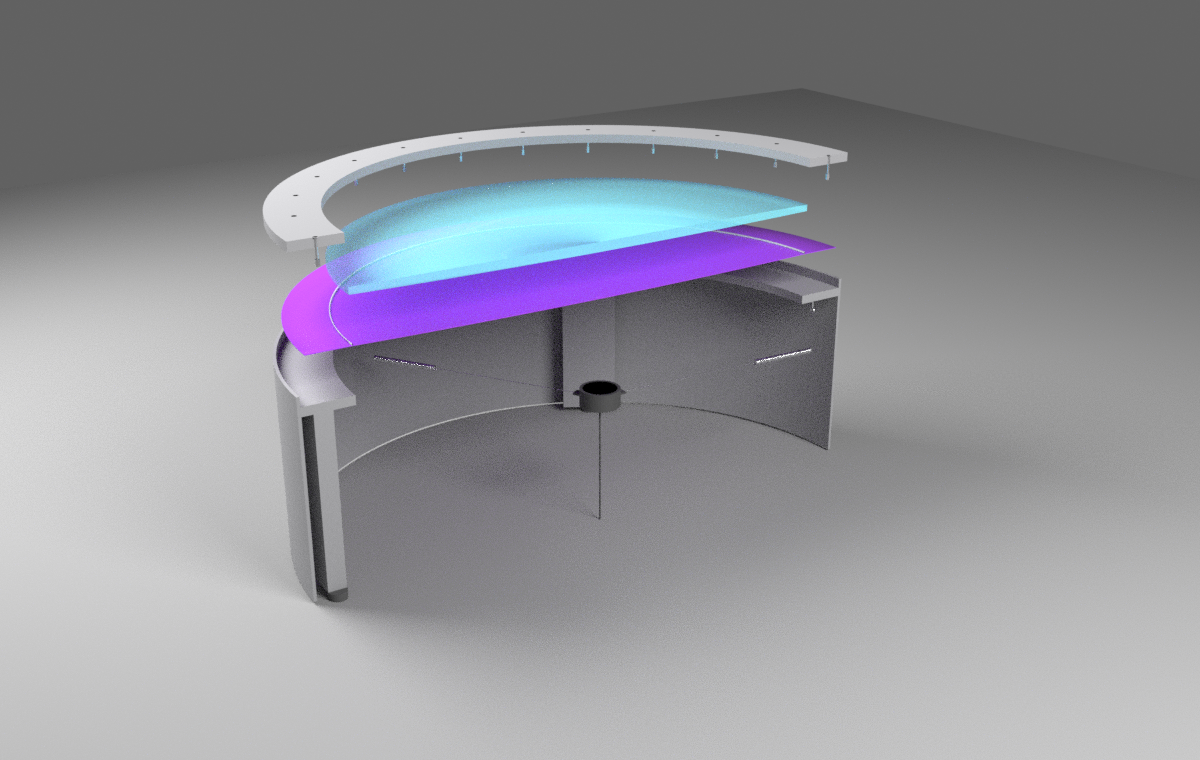
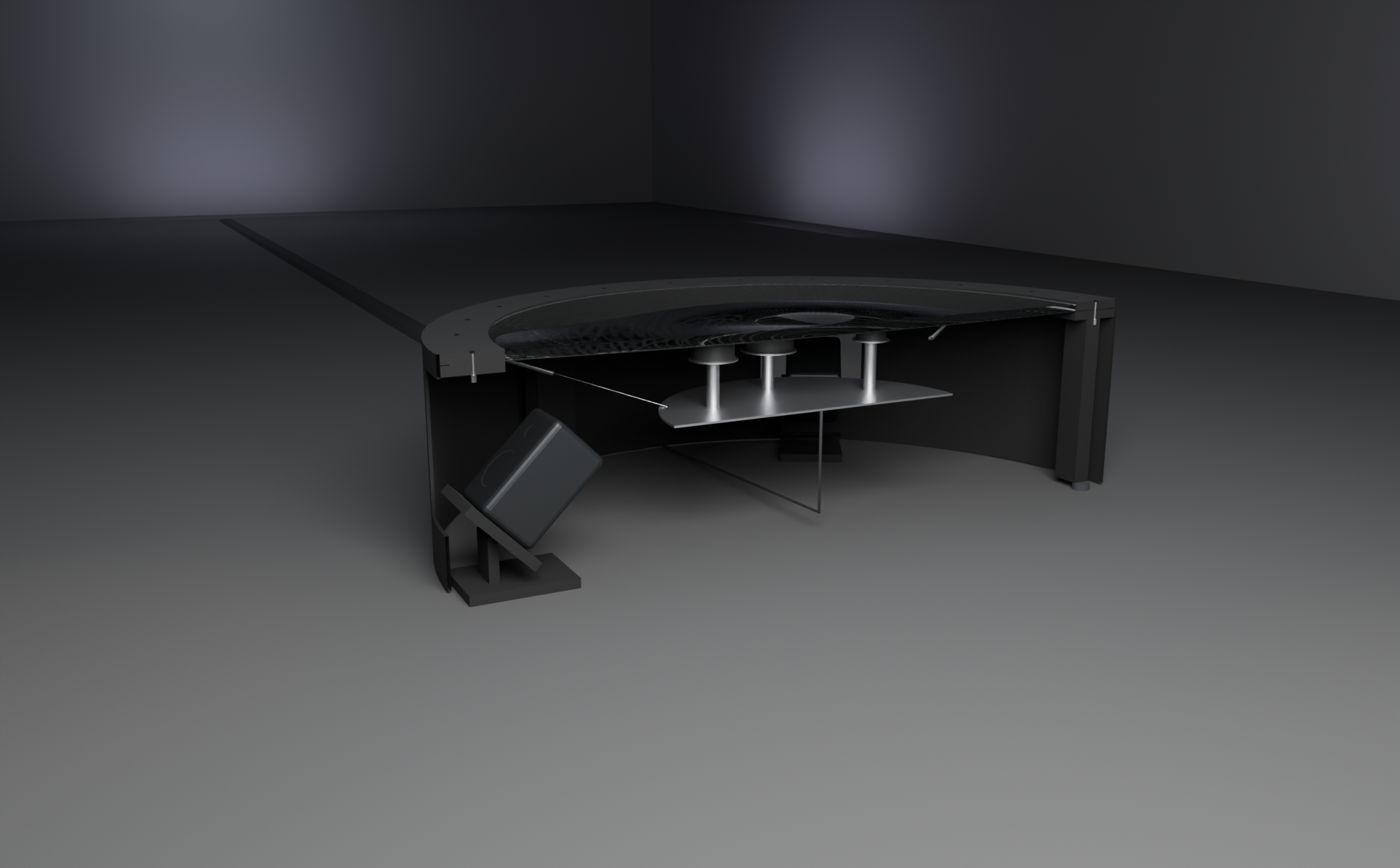
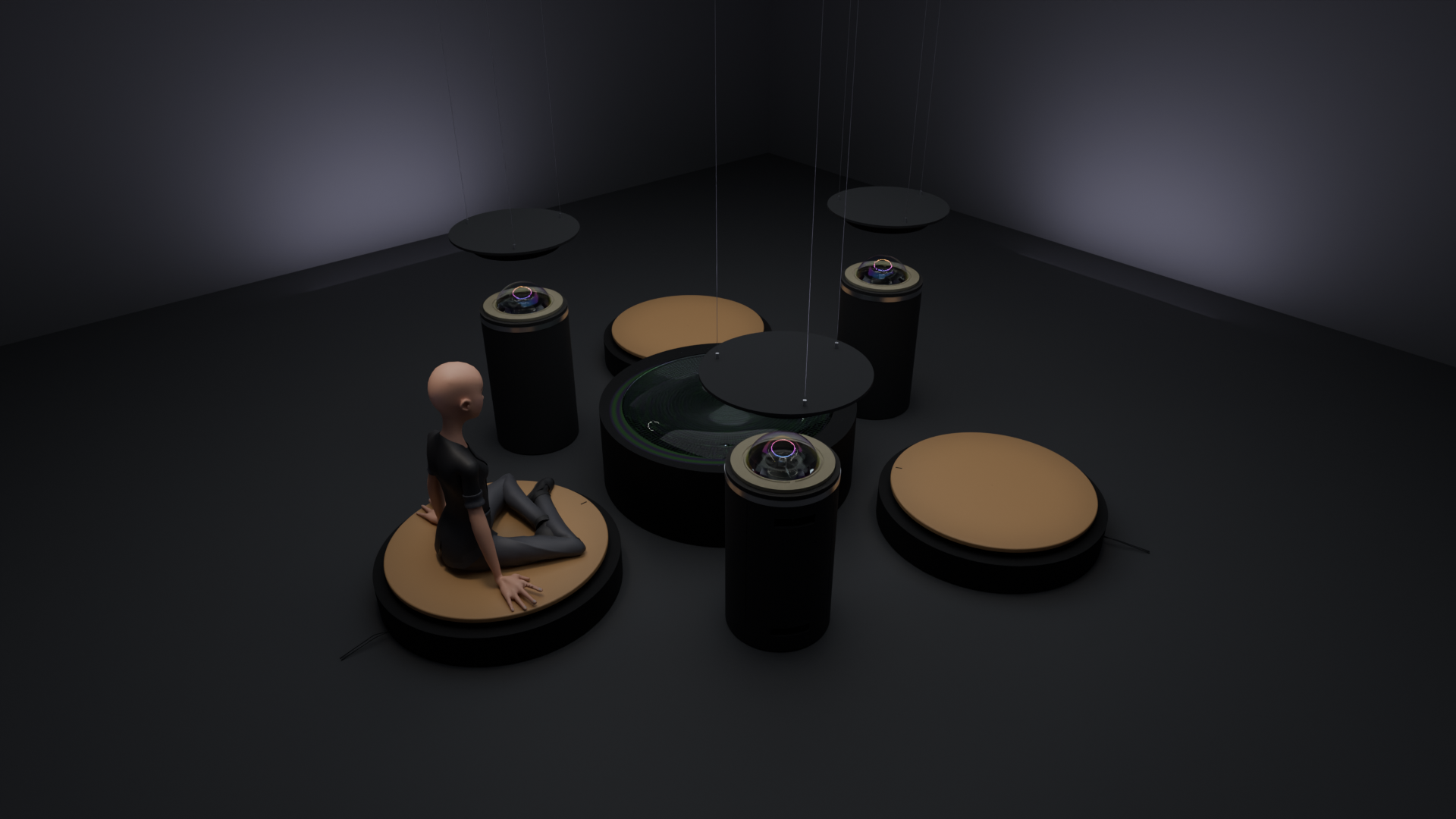
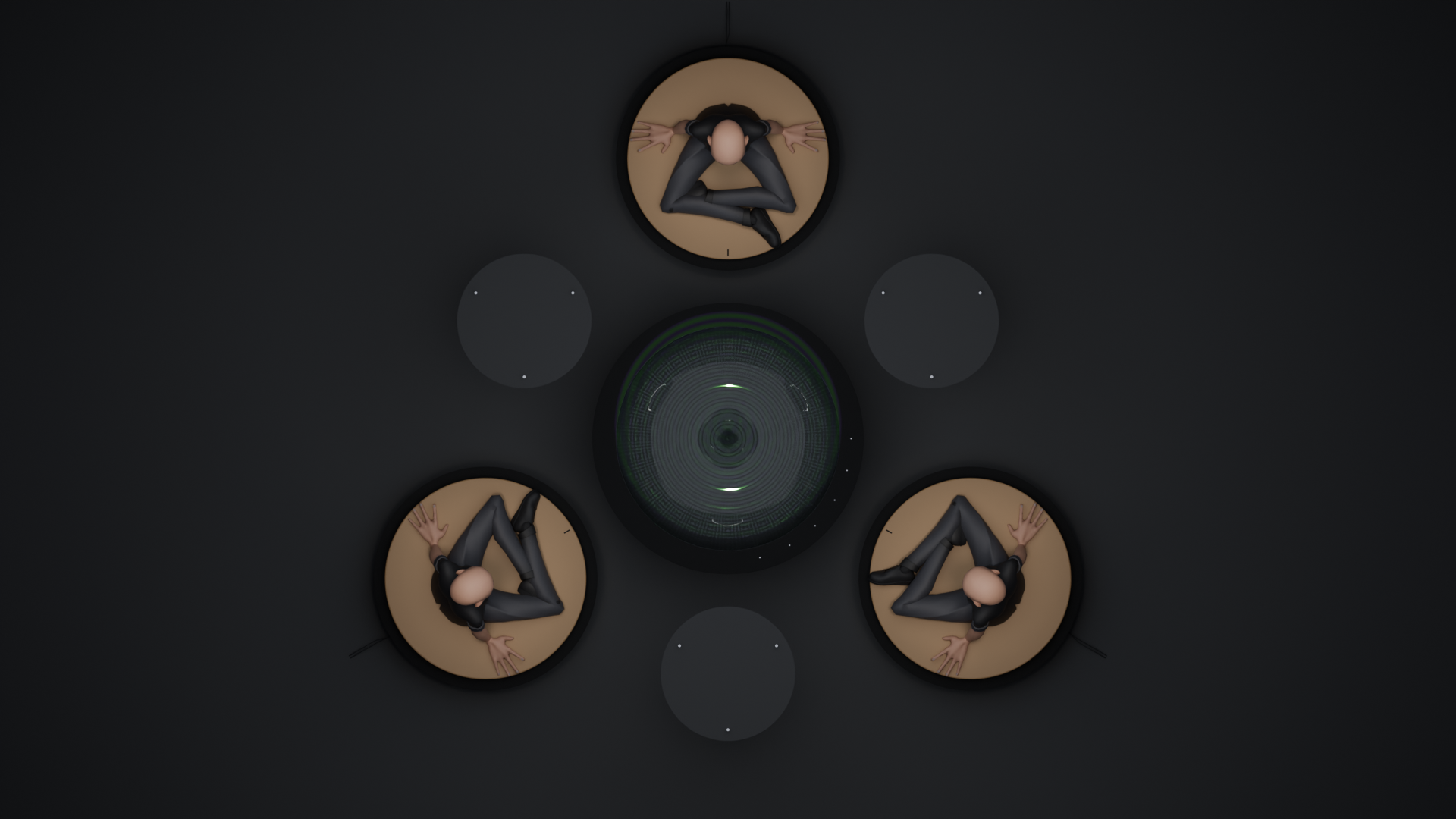
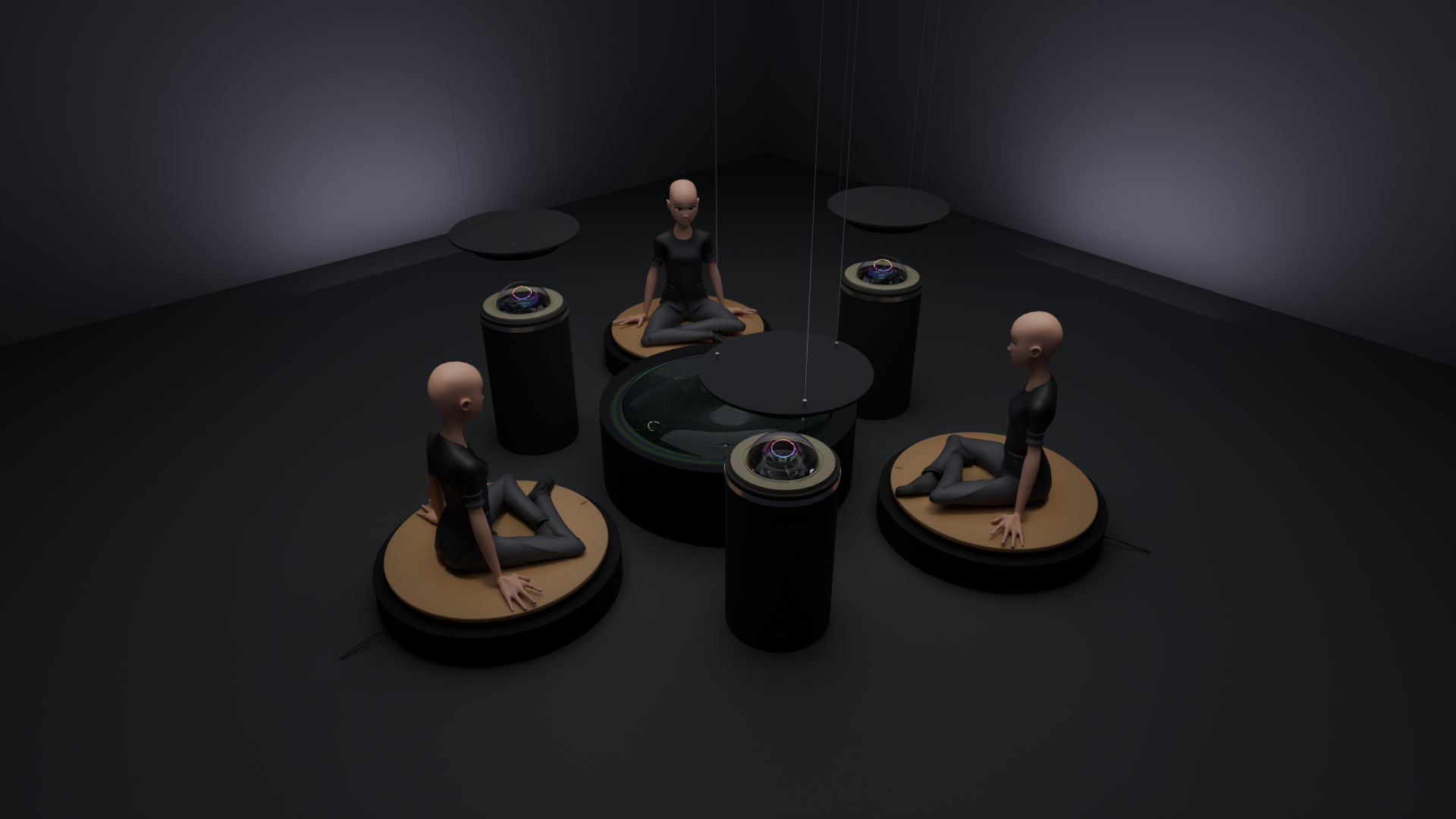
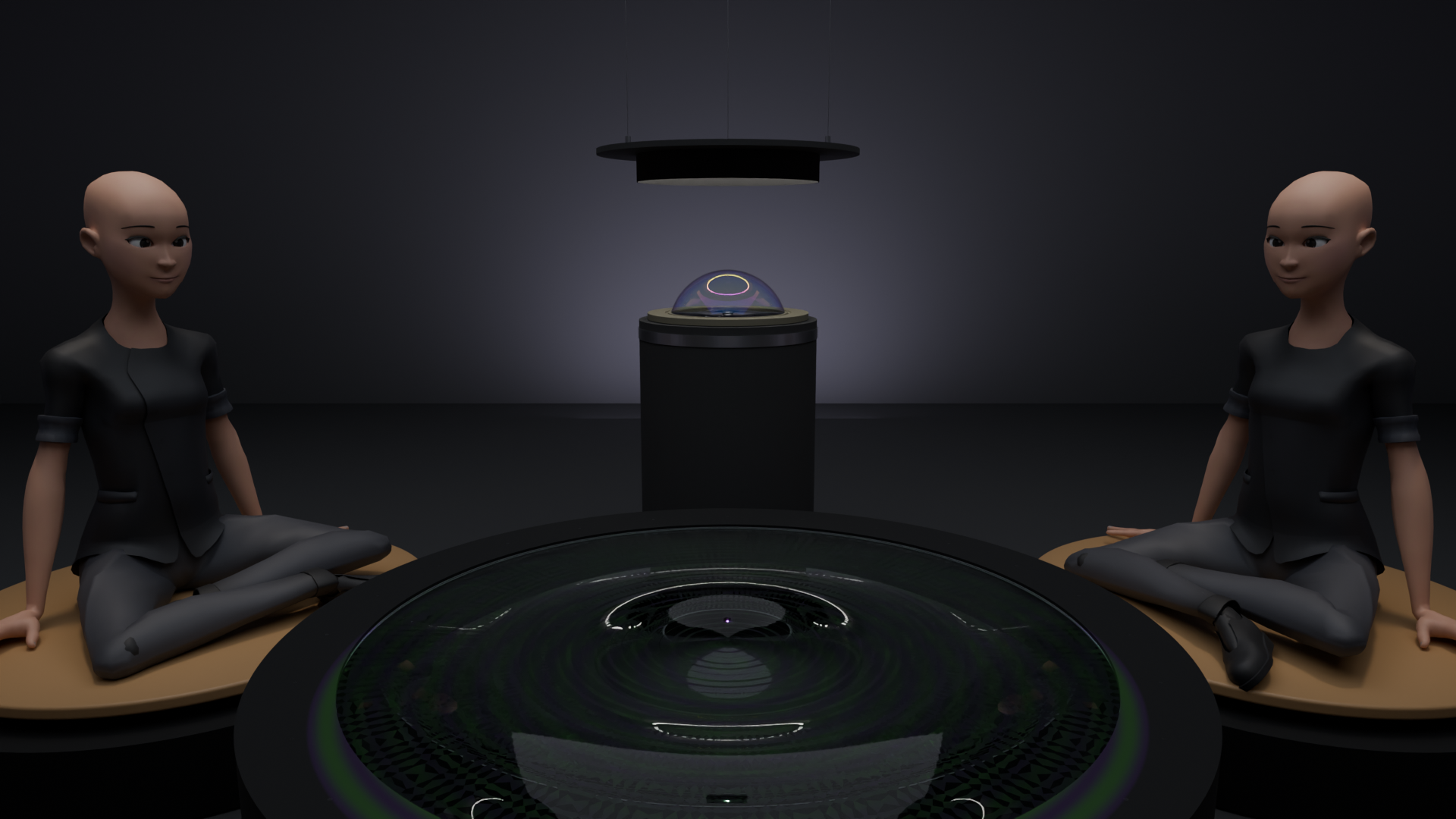
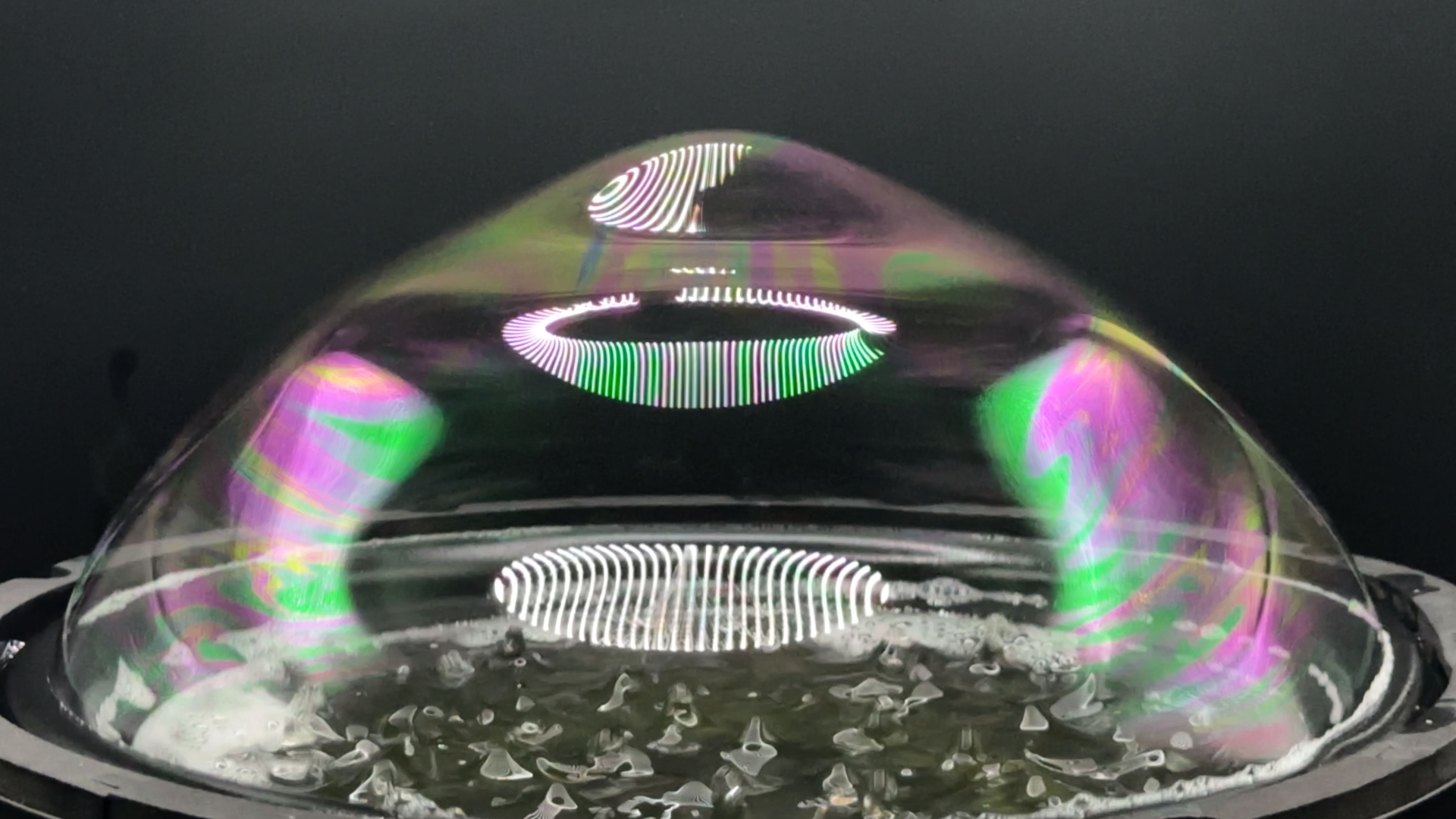
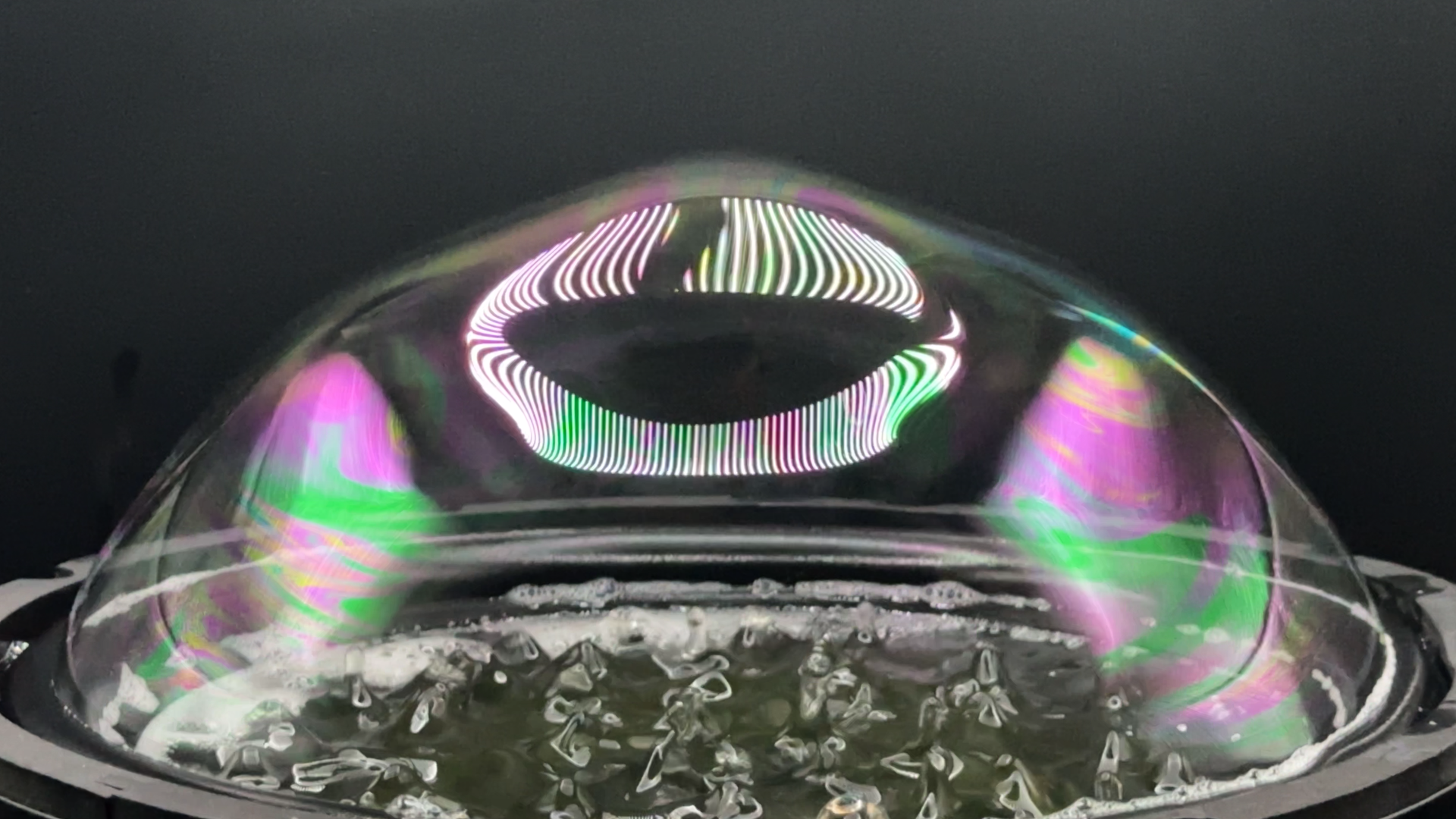
The installation consists of a central water plate, surrounded by three individual seats and three columns that hold soap bubbles. Beneath the central water plate, a membrane moved by transducers makes the surface vibrate, and images are projected onto it from above. At the top of each column a soap film forms and vibrates with the loudspeaker housed inside, responding to the sound frequencies it receives. The bubble film is ephemeral: it forms, lasts, bursts. The device is designed to create a new bubble when the previous one disappears. Sound makes the water and the soap film vibrate, and this vibration becomes visible as figures and geometries.
People sit at floor level, on low rotating seats that let them turn towards the water or towards the bubbles. Sound reaches each seat from the water plate, and the seat itself vibrates with the sound. The result is a space of expanded listening, where sound is also perceived visually and through the body.
The project is being developed with the multiethnic community of Castañal de los Lagos and with the Asociación de Mujeres Indígenas Protectoras de la Madre Tierra de Amazonas Colombia (AMIPMTAC), in Leticia, Amazonas.
Background - from the Ríos Trilogy to Kuna
Between 2018 and 2024 I developed the Ríos Trilogy, a research project on the socio-environmental dynamics of the Amazon basin, worked through digital cartographies, topographies printed in ceramics and virtual reality. Its third chapter, R€¥€R$€, received the Award of Distinction of the Prix Ars Electronica 2026 in the Digital Humanity category. Ríos Trilogy
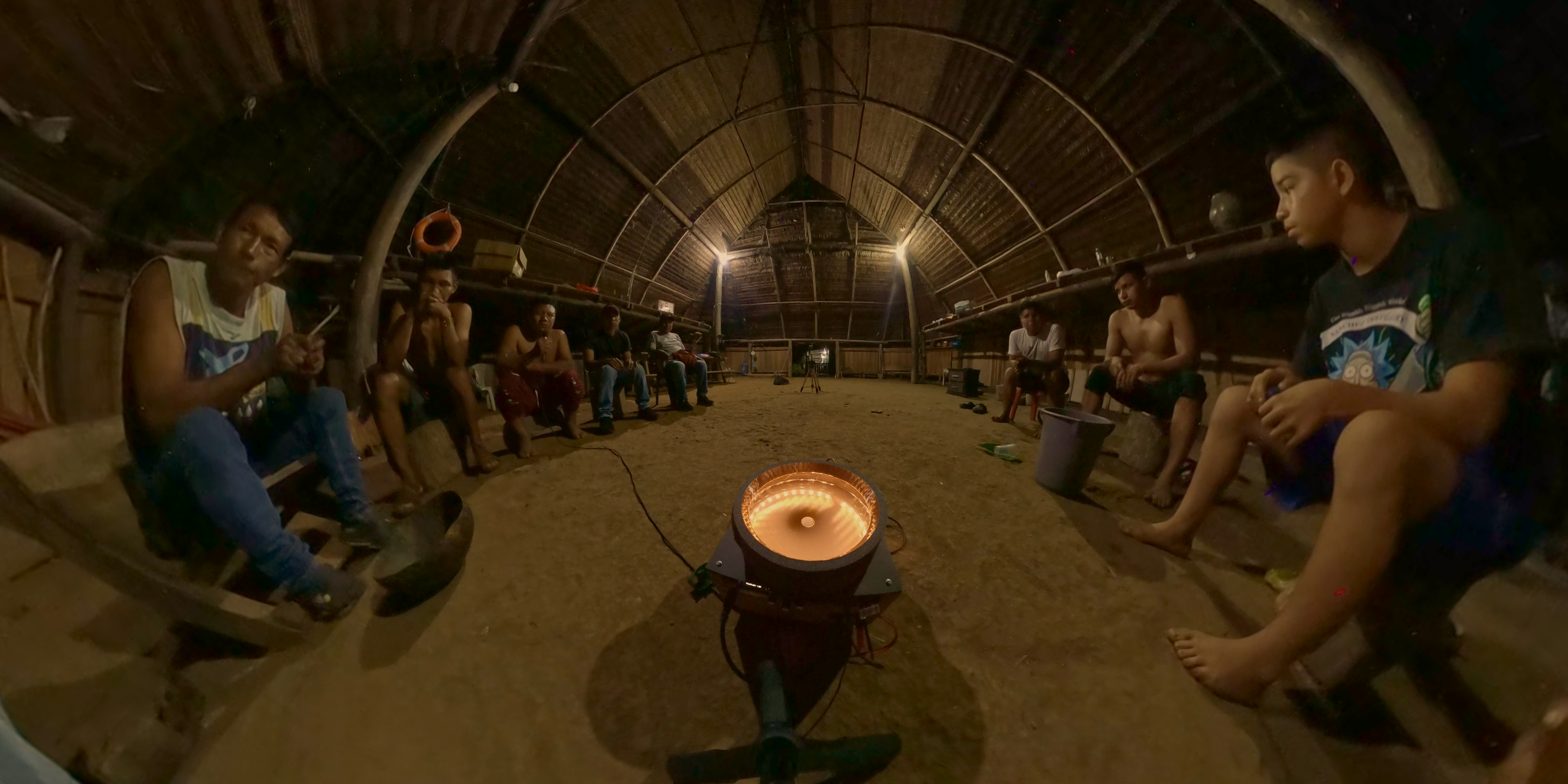
In 2023 I travelled to Puerto Leguízamo, Putumayo, to work with the Murúi Muina people. I went with Héctor Fabio Yucuna Perea, a collaborator on the project from the start, in charge of coordination and mediation with the communities, and with whom I continue to work. We were also accompanied by the Fundación Semilla. I brought an instrument built in Brussels, a device with water and electronic components that lets you see how water moves with the voice that sings a song.
We worked for weeks with the knowledge holders of the maloca. We shared songs and watched how sound travels through water and forms geometries.
More than a year went by before I understood what was missing. A voice was missing. Where were the women while we shared days and nights in the maloca? Where were they when we wrote together the stories we were going to film? I did not find out. No one told me and I did not ask. What I know is that they were not there, and that the daily work of care, feeding, listening and raising children is, there too, an invisible labour. Constant, without holidays, rarely measured at its true value.
In December 2024 I took my son to the Amazon for the first time. We flew to Puerto Inírida and travelled along the Guainía River to the multiethnic community of El Venado, made up of the Curripaco, Guanano, Puinave, Cubeo, Desano, Tucano and Piratapuyo peoples, at the foot of the Cerros de Mavecure.
One afternoon, from the riverbank, I made a small paper boat to say goodbye to a friend who had just died. I set it on the water and watched it disappear among the whirlpools.
That night I woke up at around two in the morning with a clear sentence: the path is the lullabies. In them lies the thread that makes room for women's voices and for their work as carers and protectors of the territory. The project will be called Kuna.
I got up to write. When dawn began to break, I went down to the river with the camera.
Doña Juana, of the Puinave people, appeared, coming as she does every morning to wash the dishes and bathe. She is about seventy-five years old. She told me her story and said that she did not speak her native language well. I asked her whether she would like to share a lullaby with me, and she agreed. I set up the camera. Doña Juana sang in Puinave.
That was when I understood that the language had not disappeared: it had withdrawn. That after centuries of conquest and cultural extermination there remained a basket of resistance, and that this basket was the sung communication between a woman and a small girl or boy. What is no longer spoken is still sung.
A spontaneous encounter with Doña Juana, Puinave people, Cerros de Mavecure, December 2024.
The lullabies
In the Amazon, lullabies are an almost exclusively feminine genre. They are learnt before motherhood: girls rock their younger sisters and brothers to sleep as part of play. They are sung in the house and in the chagra, only during the day. They are short, from four to ten lines, improvised, made of repetition.
They do not always soothe; they also name threats. Among the Mágüta people, one of the four peoples that make up the community of Castañal de los Lagos, in Leticia, Amazonas, where this project will be developed, the wawae lullaby names the jaguar, the dog, the vulture, the spirits that lie in wait. It is sung because the newborn is in danger: its spirit has not yet settled in its body, and its scent is new in the world. Until the age of three that body needs to be strengthened, and the song works together with dietas, amulets and breast milk, which carries thought. Crying is dangerous because it alerts those who are listening.
That is why the song goes in two directions. It speaks to the baby, and it lets the spirits know that the mother is awake.
Kuna - the installation
Kuna works with cymatics, the visualisation of acoustic vibrations in material media. Sound waves are pressure waves: they pass through matter and, in doing so, make it vibrate. Cymatics brings us closer to the possibility of seeing sound, of visualising the geometric, mathematical and frequency relationships that remain invisible.
Since 2023 we have carried out several cymatic experiments with OHME LAB, from Chladni figures with sand to the water prototype I took to the Amazon at the end of that year. This project seeks to take cymatics beyond existing explorations, working at larger scales than those commonly used so far.
Light plays a very important role in seeing the sound frequencies: the visual results arise from the interaction between particles of water and particles of light.
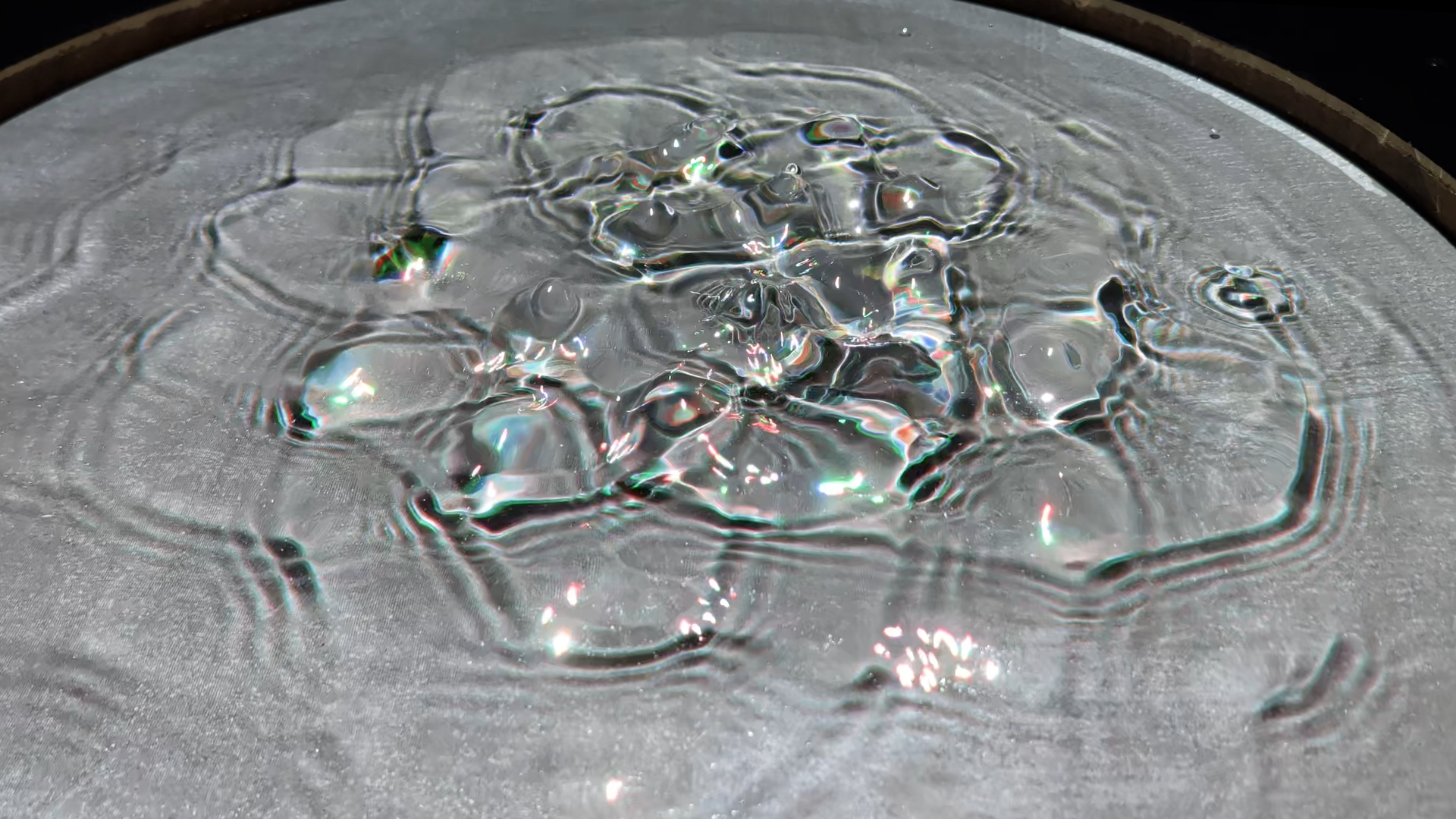
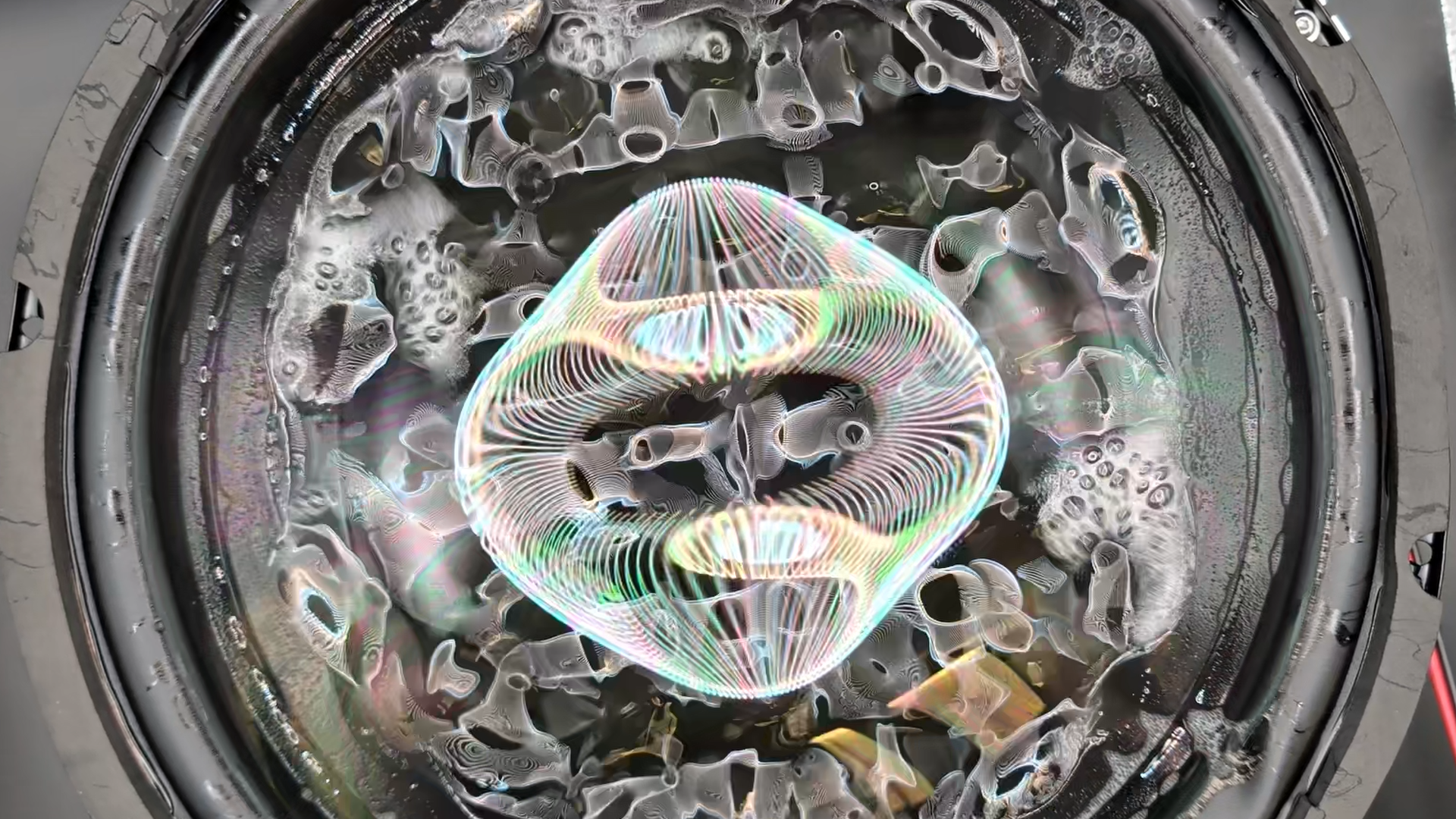
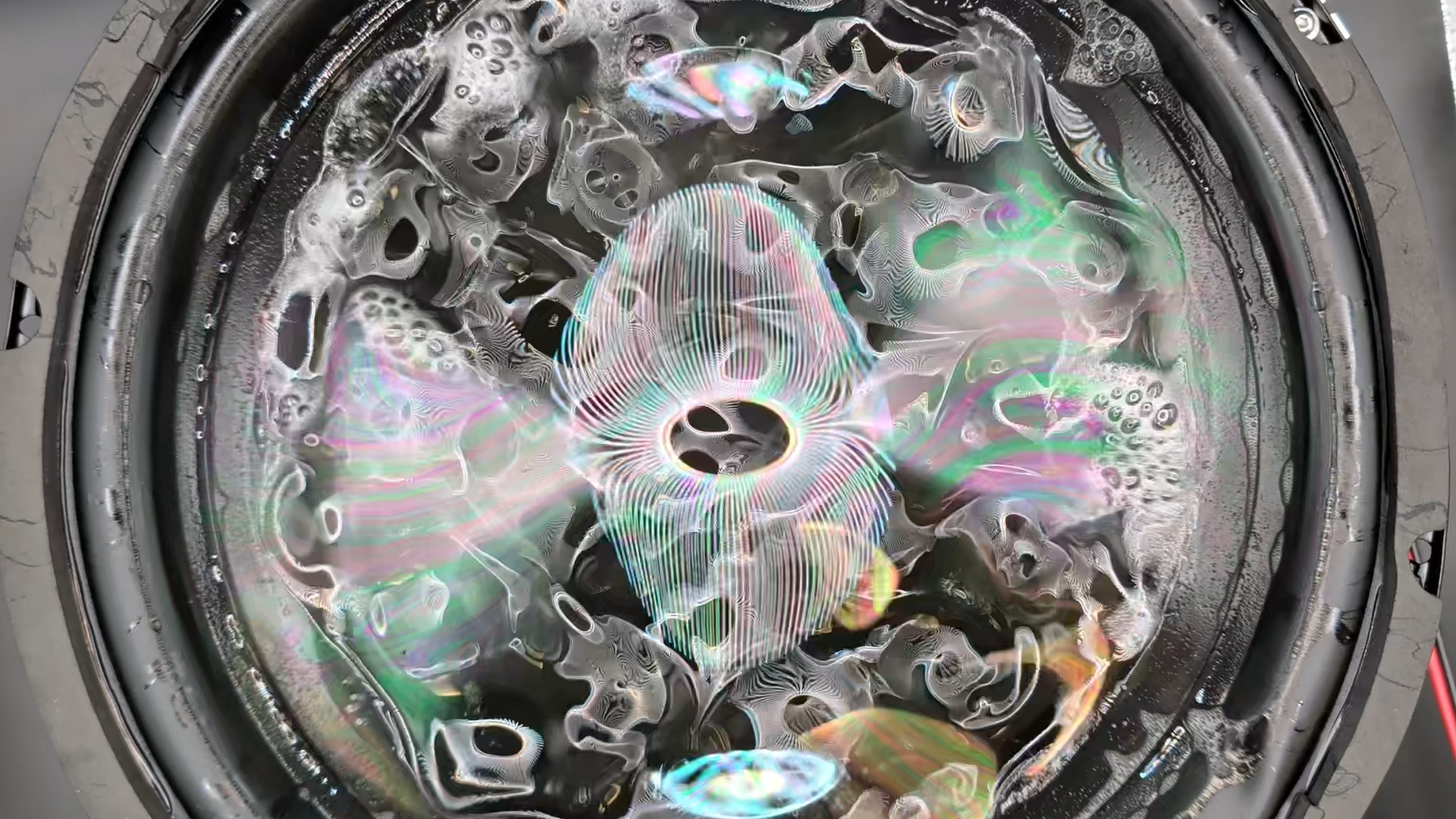
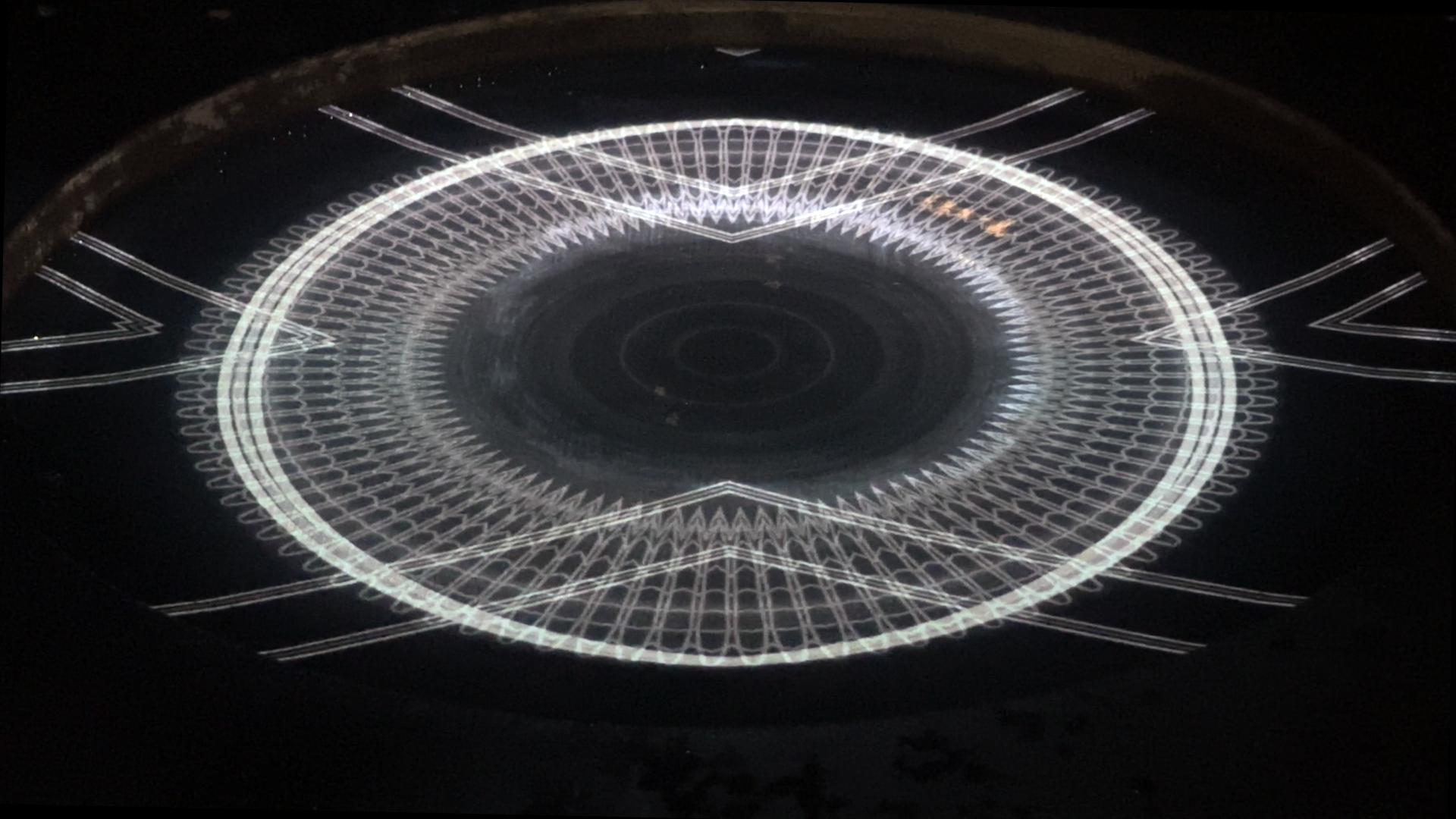
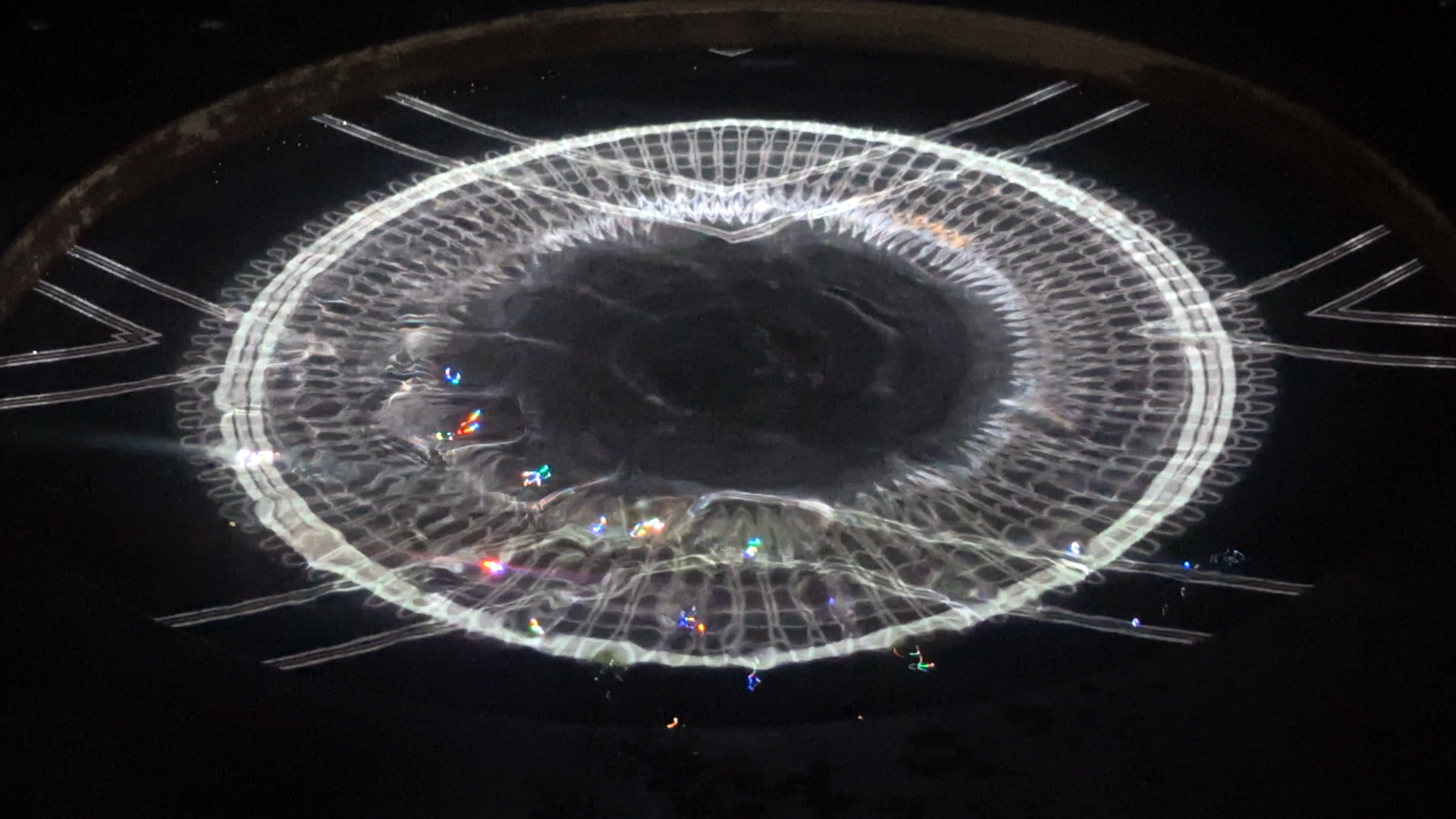
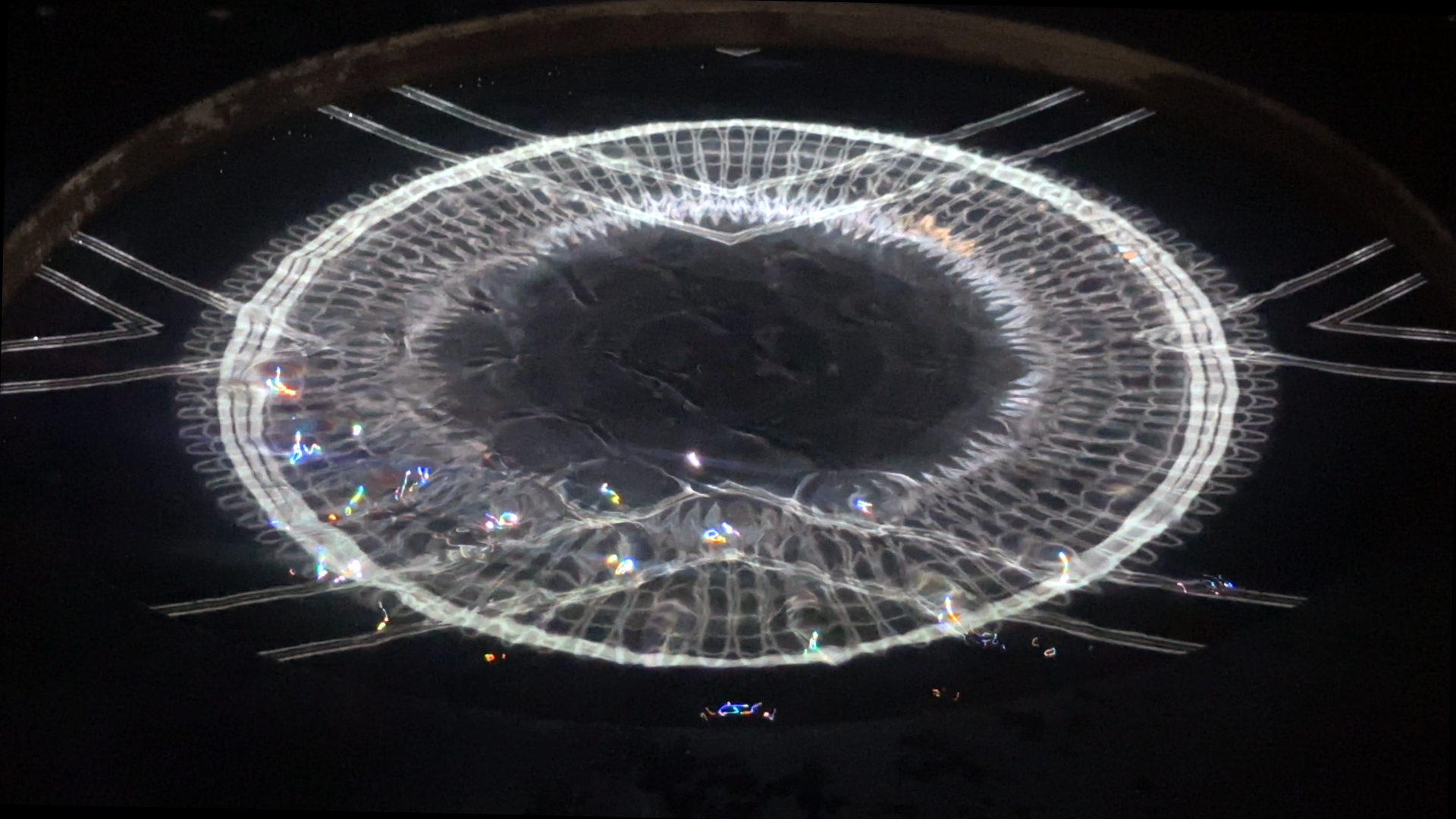
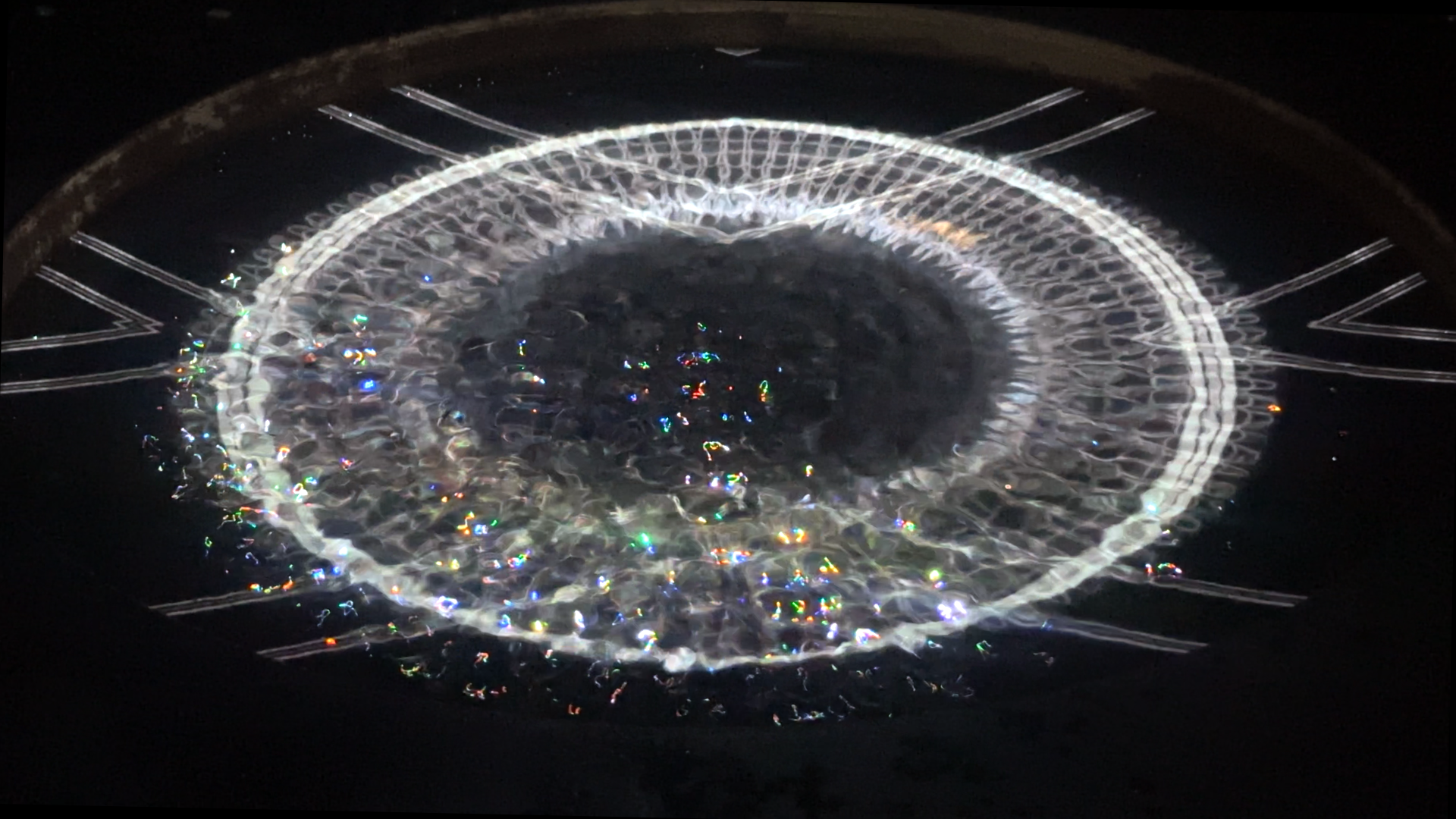
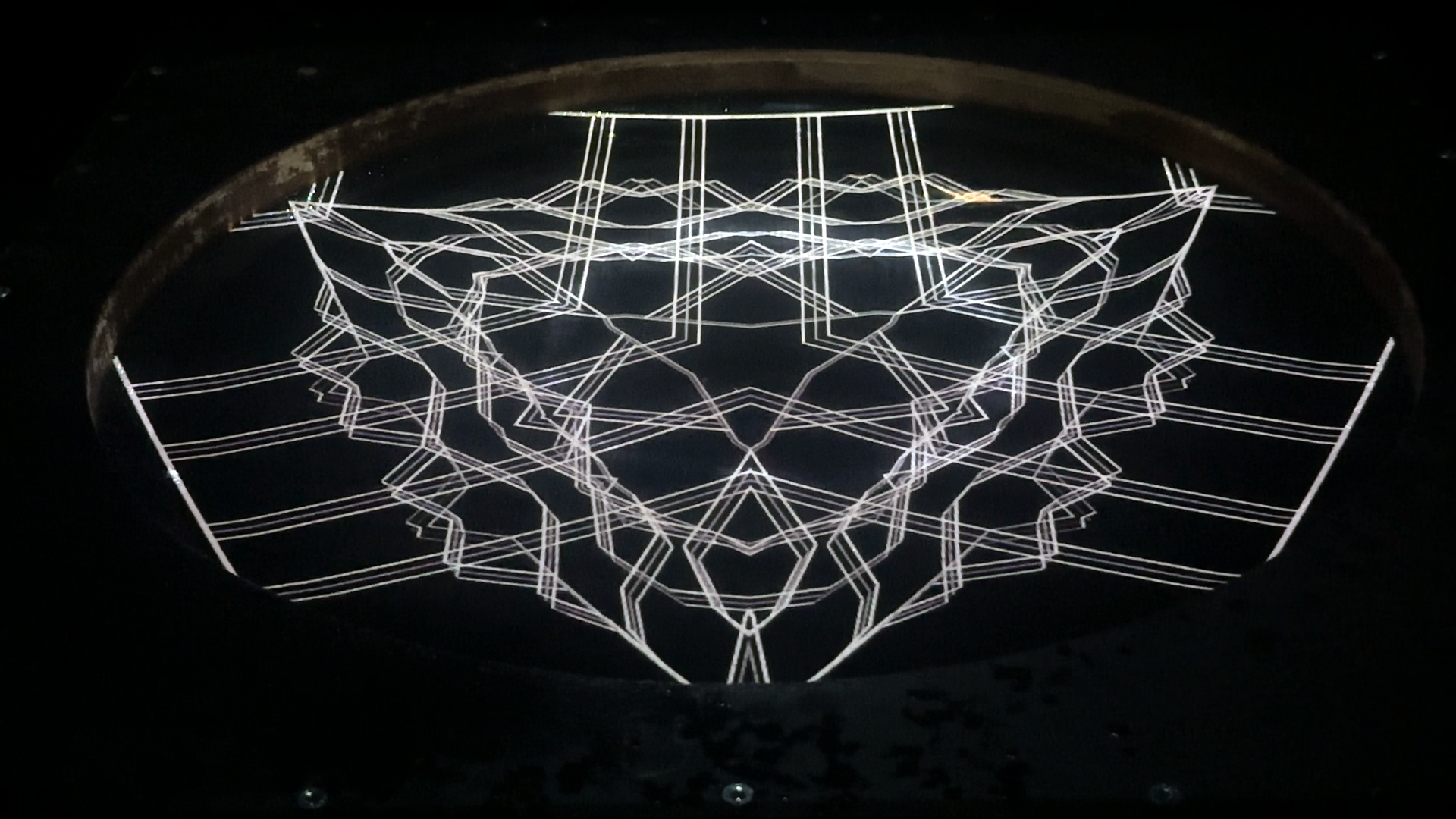
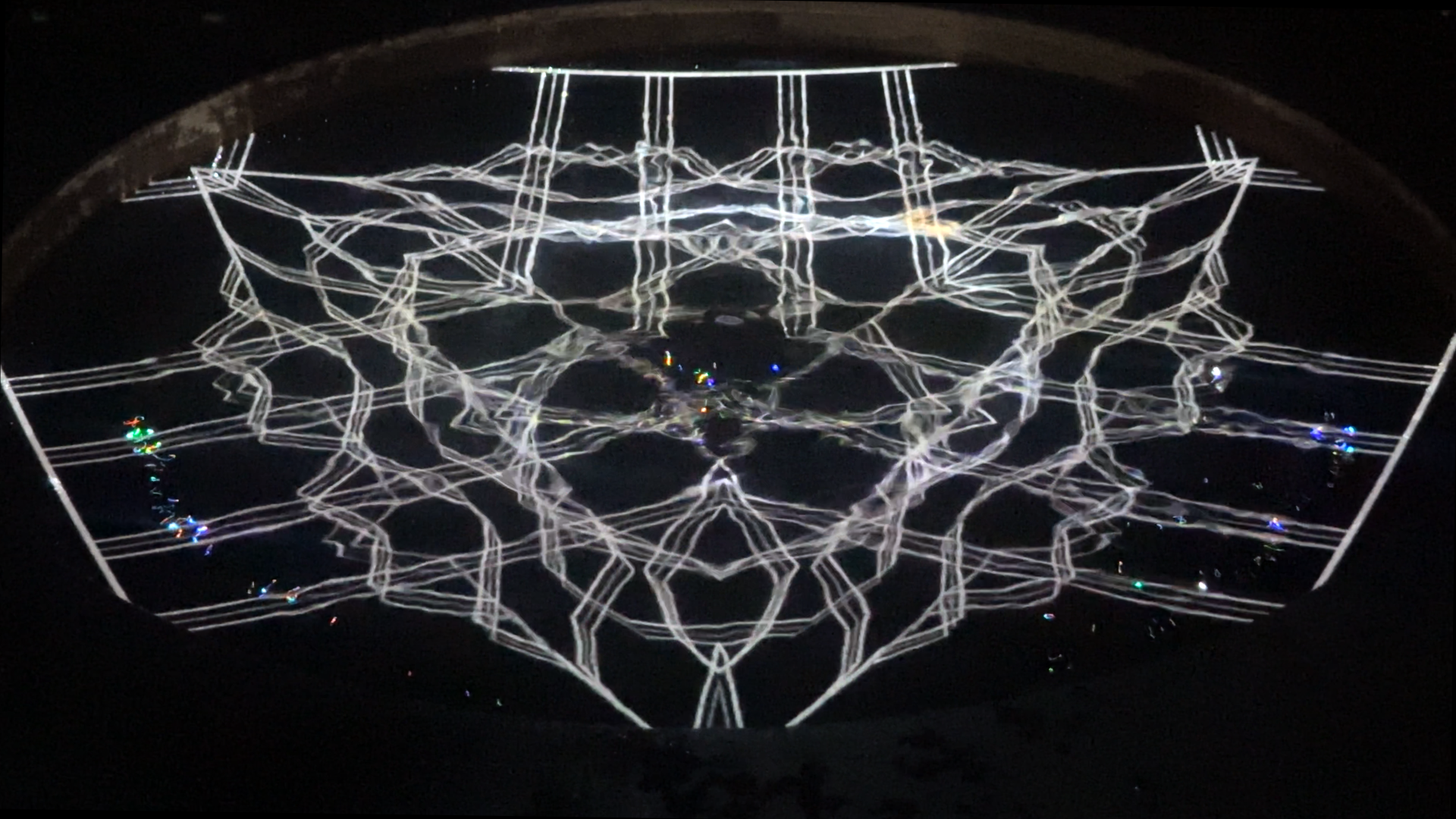
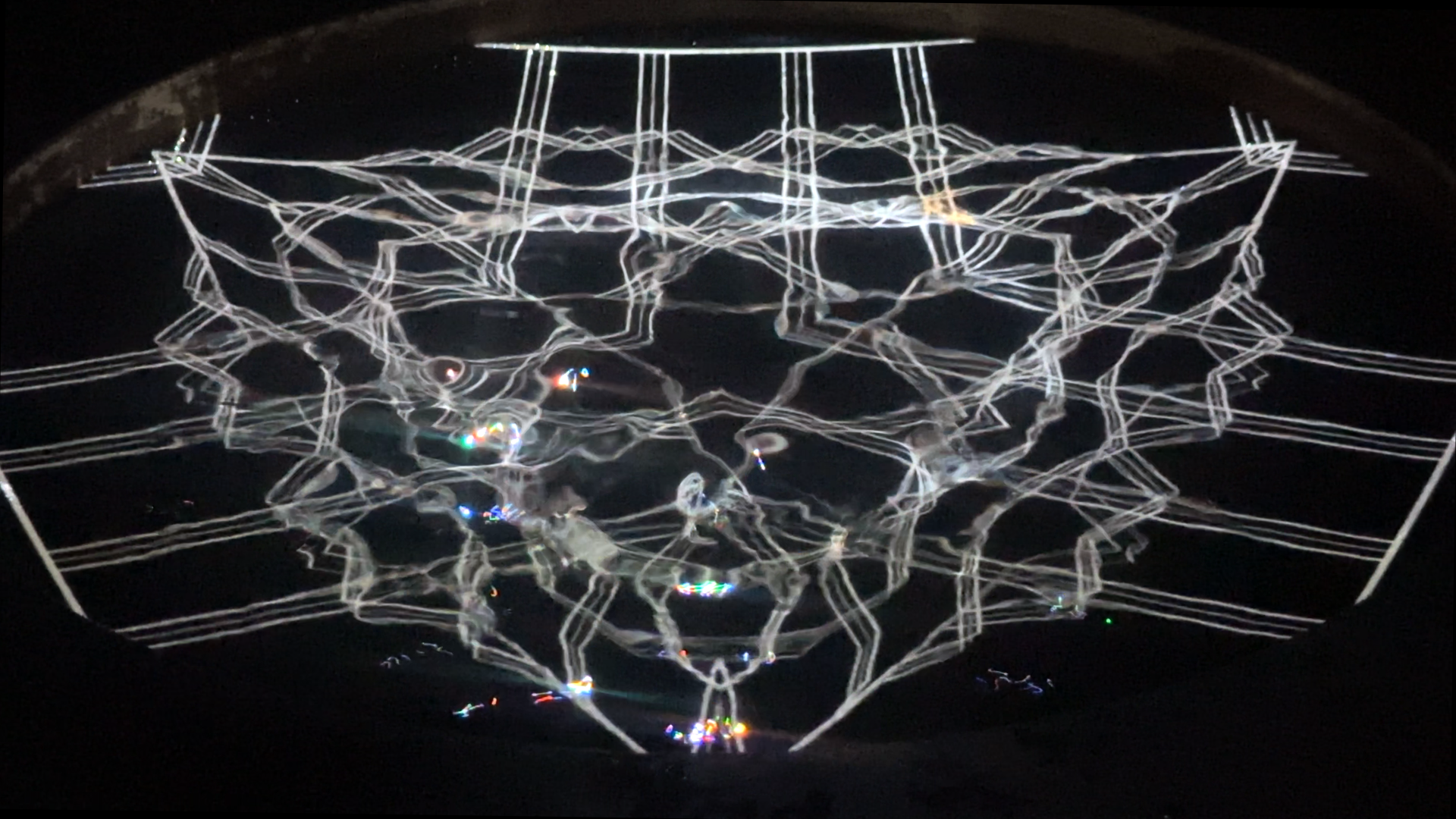
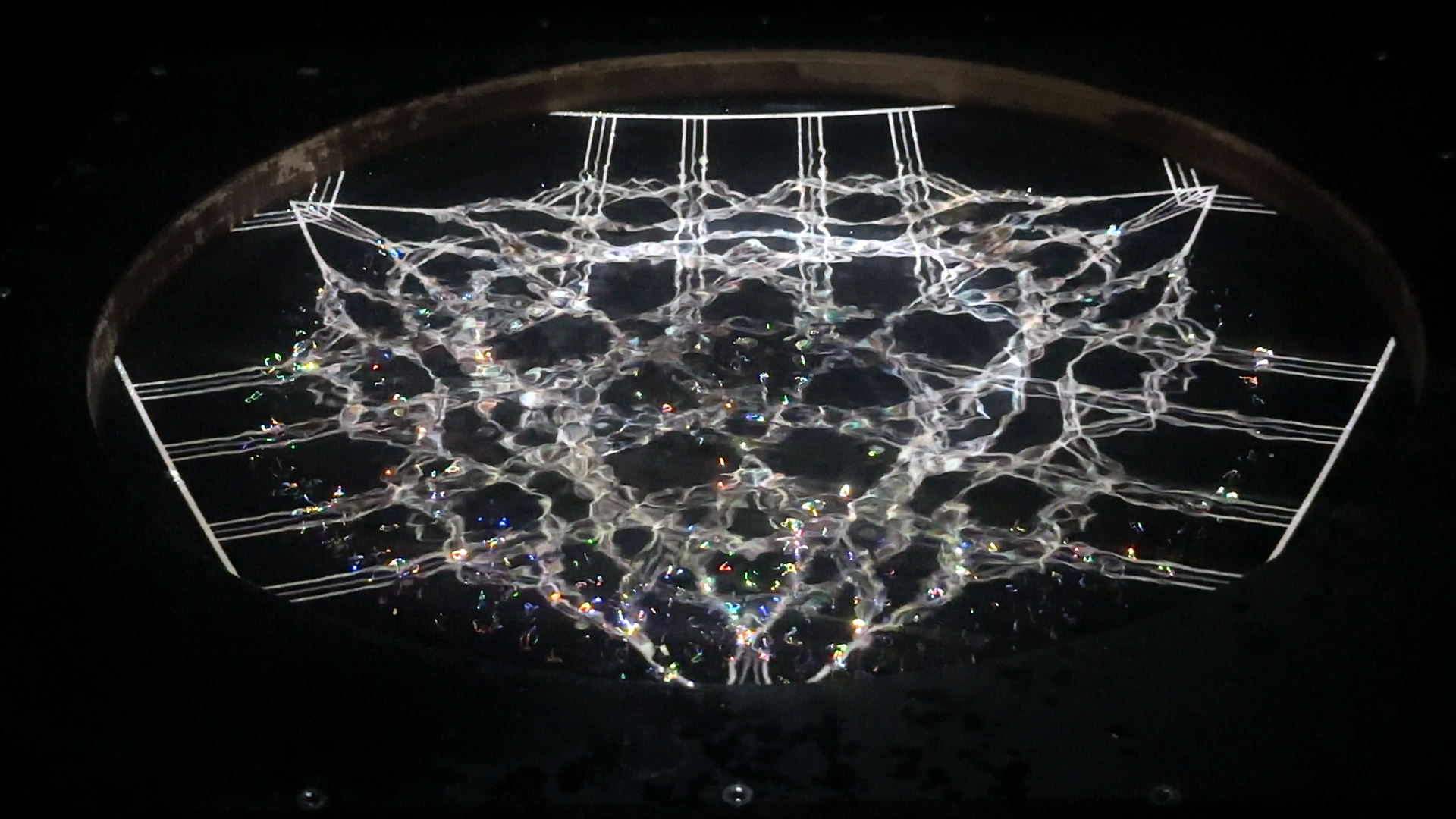
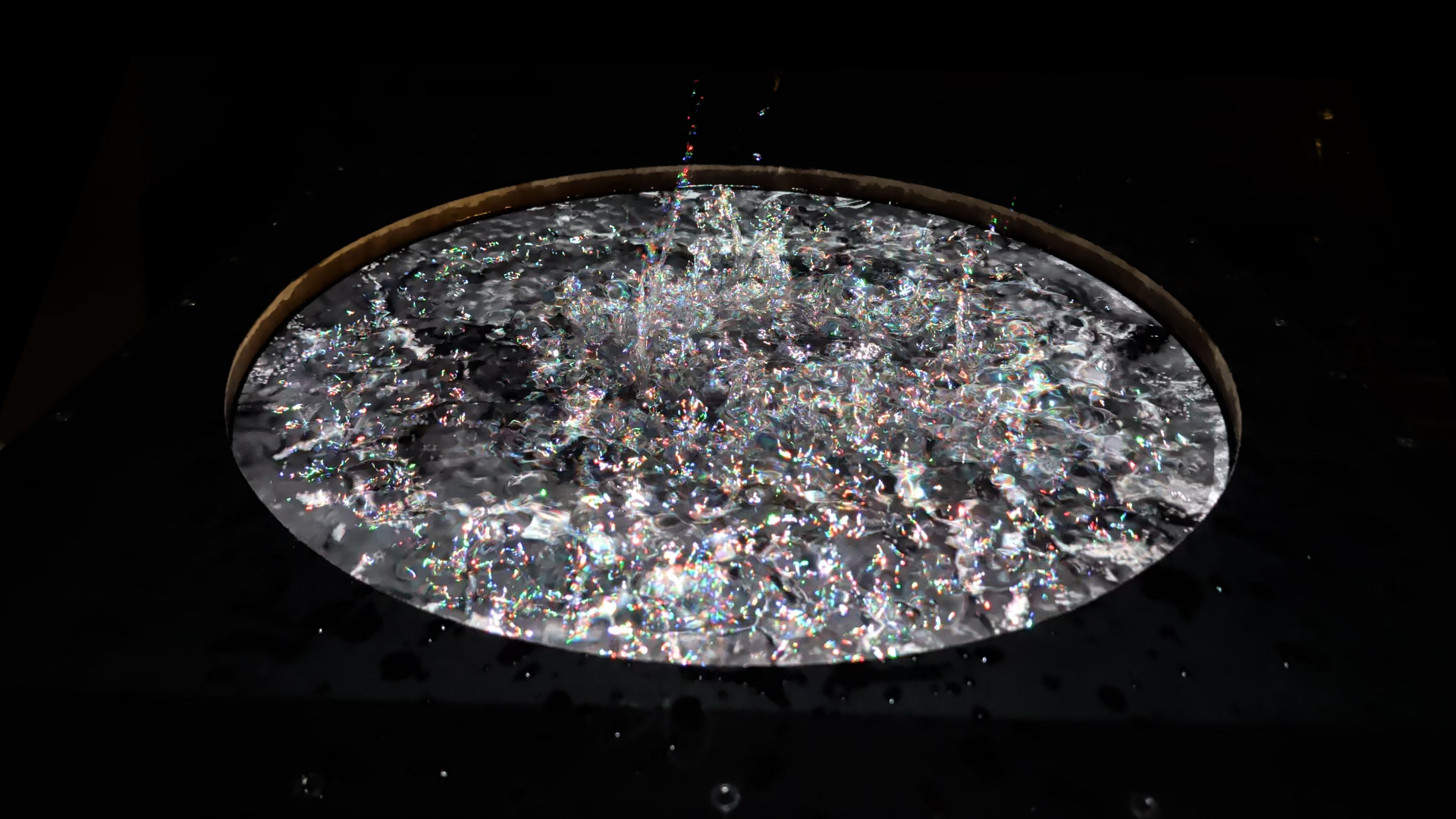
The tests with the water plate and the bubbles are documented in photos and videos:
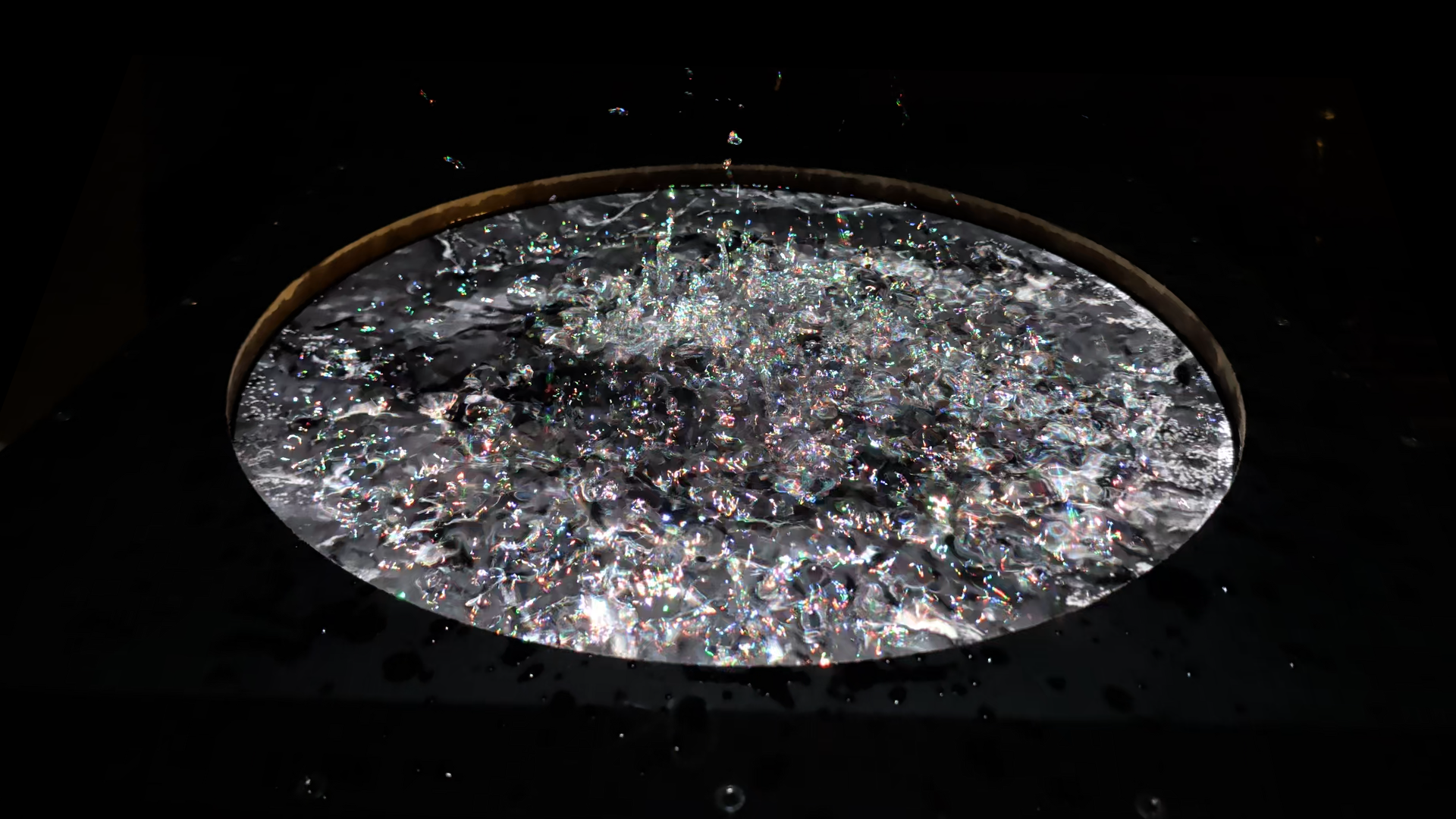
The water plate
The plate measures 120 cm in diameter. With OHME LAB we have already built a working prototype of the water plate with projection. When working with high-contrast images, the sound waves are visible only in the lit parts of the image, which creates a very particular interaction between light and water.
The projected images are computer-generated, 3D animations that I make myself. In the first tests I projected water created in 3D onto real water, and the result is striking. Another line I am exploring is river beds seen from above, with stones, algae and fish. The final content will be defined during production.